Site clearing contractors in Lowell, AR deal with a specific mix of terrain: mixed hardwoods, rolling hills, and heavy clay soil that behaves differently once the trees come down. Skip a step in that process, from stump grinding to compaction testing, and a foundation can settle unevenly years later. Here's what the process actually involves, what it costs going into 2026, and what separates a crew that's worked this terrain before from one that hasn't.
Our crews handle every stage of that process in-house, from the first cut to the final grade. See how the pieces fit together on our homepage, or jump straight to the section you need below.
Land & Brush Clearing
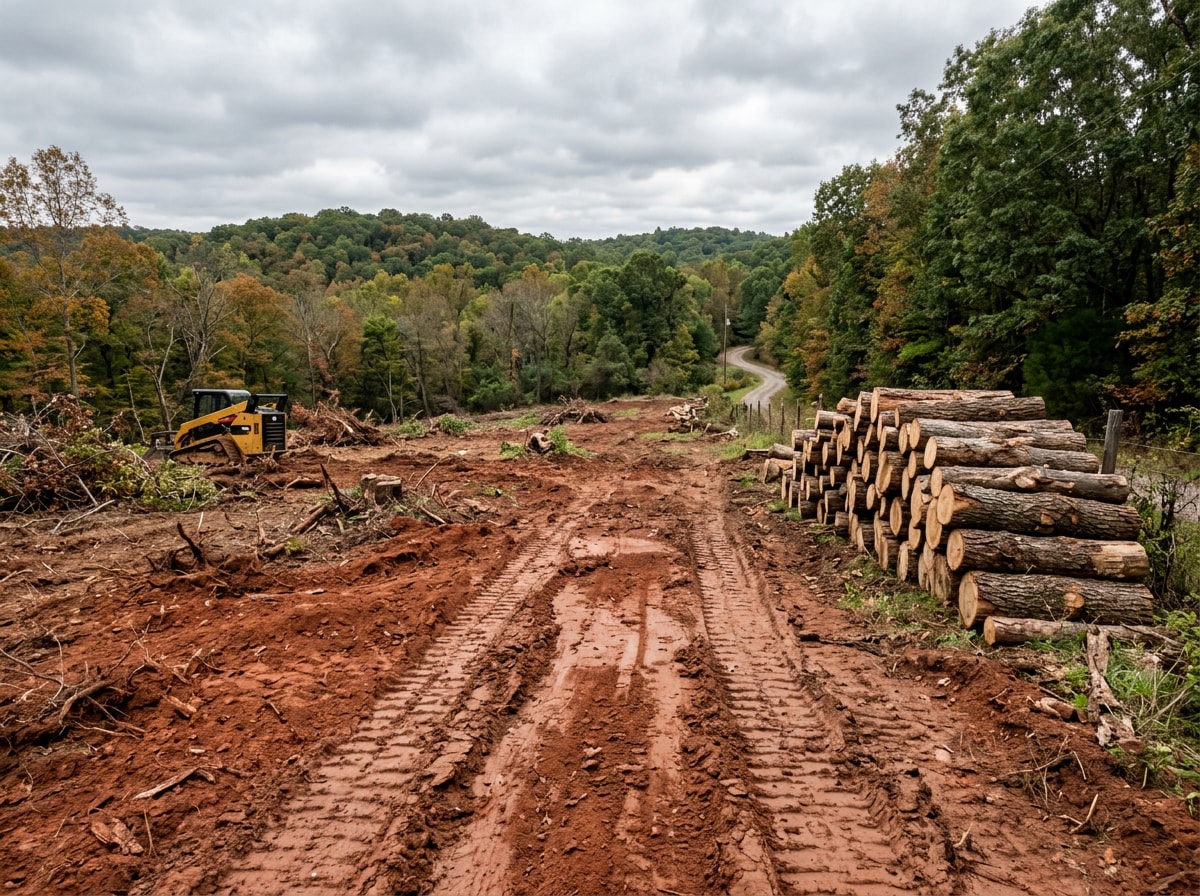
Most projects start with land clearing and brush clearing, removing undergrowth, saplings, and overgrown vegetation to make a lot usable again. Crews typically use mulchers and skid steers for this stage, since that equipment chews through brush without the deep excavation a full lot clearing project needs. A quarter-acre yard calls for a different scope than a ten-acre pasture, and pricing follows that difference.
Clear-Cutting & Full Lot Clearing
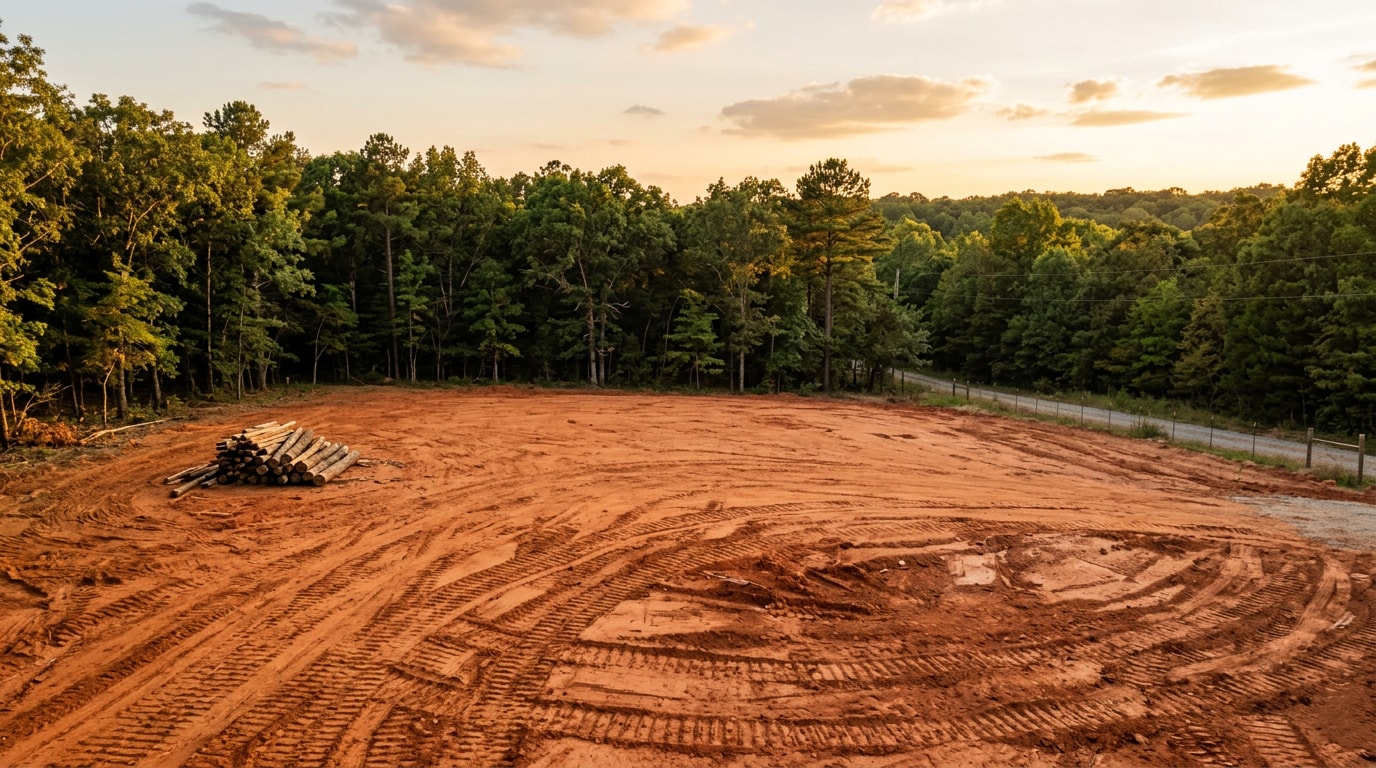
Clear cutting removes every tree, stump, and root mass from a lot, leaving bare ground ready to build on. It's the standard approach for new-build homesites where grading starts right after. Partial clearing, by contrast, keeps select trees in place for privacy, shade, or erosion control.
Full lot clearing always includes stump grinding, since leftover stumps interfere with grading equipment and future foundations. Debris haul-away is part of the package too. Downed trees, root balls, and brush piles need to leave the property rather than get burned or buried on-site, which can cause settling problems later. For a half-acre to one-acre homesite, this stage usually takes a few days, depending on tree density and how easily equipment can reach the lot.
What Does Site Clearing Cost in Lowell, AR?
Pricing varies more by vegetation density than almost anything else. Across Northwest Arkansas, costs generally fall into these ranges:
| Clearing Type | Typical Cost Per Acre |
|---|---|
| Light brush, saplings, flat ground | $1,500 – $2,500 |
| Medium brush and small trees (most common in NWA) | $2,500 – $4,000 |
| Heavy brush and mature trees | $4,000 – $6,000+ |
| Stump grinding (add-on) | $400 – $3,000 |
| Grading and leveling after clearing | $1,000 – $4,000 |
These figures reflect land clearing costs in Northwest Arkansas generally falling between $1,500 and $6,000 or more per acre, with light brush and saplings on flat ground running $1,500 to $2,500 per acre, medium brush and small trees costing $2,500 to $4,000 per acre, heavy brush and mature trees pushing $4,000 to $6,000 or higher, stump grinding adding $400 to $3,000 per acre, and grading adding $1,000 to $4,000 per acre . Worth noting: Benton and Washington County projects can run toward the higher end of statewide ranges or beyond, since Benton & Washington Counties (Northwest AR) typically see $5,000 to $10,000 per acre due to high demand and more expensive contractors compared to slower-growth parts of the state. Lot size also matters a lot here, since mobilization and setup costs stay roughly fixed whether you're clearing a half-acre or ten acres, which pushes small-lot pricing higher per acre than large tracts.
Those numbers are starting points, not quotes. Get a free estimate for a number specific to your lot's tree density, access, and grading scope.
Tree & Storm Work
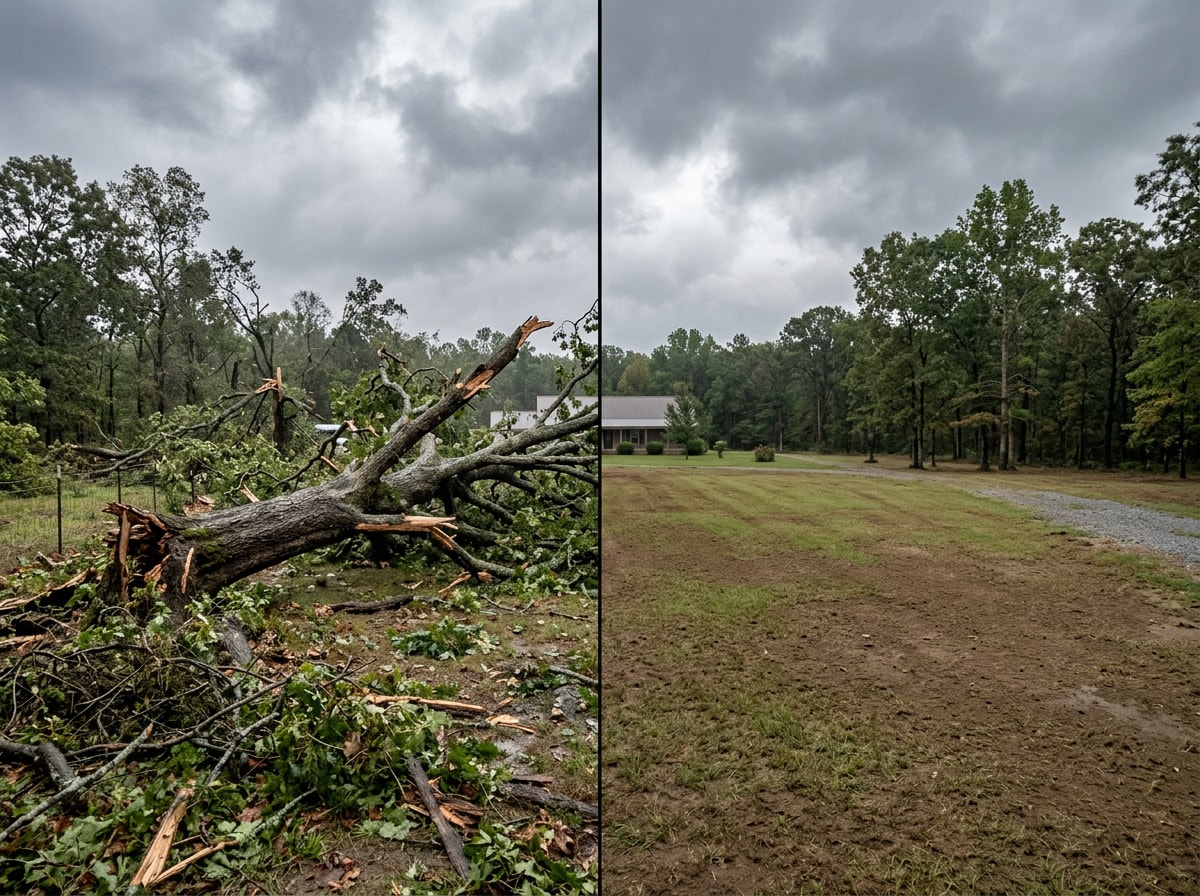
Tree removal is a natural extension of land clearing, but it also stands alone after severe weather. Arkansas storms bring down healthy trees along with dead ones. Storm cleanup after a windstorm or ice event often needs to happen fast, especially when a downed tree blocks a driveway or leans toward a structure.
Downed tree removal differs from routine arborist trimming in scale and urgency. A tree service built for seasonal pruning isn't necessarily equipped to assess a hazard tree leaning over a roofline or pull a root-balled oak out of soft ground after a storm. Site clearing crews bring heavier equipment, including grapple trucks, stump grinders, and chippers, plus the experience to judge which remaining trees are structurally compromised and need to come down before they fail on their own.
Site Prep & Excavation
Once a lot is cleared, site preparation takes over. This is where excavation turns raw, cleared ground into a buildable surface: grading the pad, cutting in rough utility trenches, and setting the stage for a foundation crew. Clearing and site prep are usually sold together, since the second phase depends entirely on how cleanly the first one was done. If you're weighing a lot purchase against building new, our spec home vs. custom home guide for Lowell, AR covers how site conditions factor into that decision.
What Site Prep & Excavation Really Involves
Site preparation follows a set sequence: clearing, grubbing, rough grading, compaction testing, and fine grading. Each step builds toward a stable building pad. Skipping or rushing any one of these stages is the most common reason foundations settle unevenly later.
Picture a half-acre homesite in Lowell. After the trees and brush are cleared, grubbing removes remaining roots and organic topsoil that won't support a structure. Rough grading then shapes the lot to planned elevations, cutting high spots and filling low ones.
This is where Northwest Arkansas's clay-heavy soil becomes a factor. Clay compacts differently than sandy or loamy soil and holds water longer. On the clearing and grading jobs we run around Lowell, that clay typically needs two or three extra compaction passes beyond what sandier ground would require before a test passes, and sometimes a different fill material altogether.
Compaction testing confirms density before anyone builds on top of it. A failed test means the area gets reworked rather than covered up. Fine grading is the last step, smoothing the surface to exact elevations so water drains away from the structure instead of toward it. Our residential construction services pick up right where this stage ends.
Drainage & Infrastructure
Clearing and grading change how water moves across a property, and that shift needs a plan. Without proper drainage, cleared land is prone to erosion, standing water, and a driveway or road base that fails within a season or two. A contractor handling the clearing should coordinate grading and infrastructure prep together, not treat them as two separate jobs.
Keeping Water Away and Roads Solid
Culvert installation, graded swales, and compacted gravel road base are the main tools for keeping water off a cleared site and keeping driveways solid under vehicle weight. Culverts route water under driveways and access roads instead of letting it pool against them. Swales redirect surface runoff away from building pads.
Timing matters too. Clearing before heavy spring rainfall, when soil is driest and most stable, tends to go smoother and leave fewer erosion problems than clearing in the middle of a wet season.
Excavation & Sitework Services
Site clearing projects rarely stop at clearing alone. Most property owners in Lowell pair it with adjacent sitework, including grading, demolition, driveway excavation, trenching, and earth moving, handled by the same excavation contractor to keep scheduling and equipment mobilization simple.
Grading
Rough grading shapes a cleared lot to its planned elevations; finish grading refines the surface afterward for landscaping, driveways, or a building pad. Grading always follows clearing, since loose brush and stumps make accurate land leveling impossible.
Demolition
Some lots come with an old structure, shed, or foundation that needs to go before clearing is complete. Demolition handles structure removal separately from tree and vegetation work, since debris handling and safety requirements differ significantly.
Driveway Excavation
Once a lot is cleared and graded, driveway excavation cuts the path and prepares the base layer for gravel or paving. This step typically follows right after lot clearing, since equipment access depends on a defined travel route.
Trenching Services
Utility trenching for water, power, or drainage lines usually happens after a site is cleared and graded, since trench lines need to follow the final grading plan. Trenching involves real safety requirements around depth and shoring. Employers should ensure there is a safe way to enter and exit the trench, keep materials away from the edge, look for standing water or atmospheric hazards, and never enter a trench unless it has been properly inspected . OSHA's trenching and excavation safety standards apply to any trench a crew works in, regardless of depth.
Earth Moving
Earth moving balances cut-and-fill across a site, hauling dirt from high spots to fill low ones rather than trucking excess material off-site whenever possible. That balance keeps a project's cost and timeline more predictable.
Permits, Licensing & Regulations in Lowell, AR
Permit requirements vary by project size and jurisdiction, so it pays to check before equipment shows up. The City of Lowell requires grading permits for land-disturbing work within city limits, and applications can be submitted along with building, demolition, and other permit types listed on the city's permits page .
Larger projects carry state-level requirements too. The NPDES General Construction Permit requires all construction sites that disturb one acre or more of soil to obtain general permit coverage and to develop, implement, and maintain a Stormwater Pollution Prevention Plan designed to minimize the discharge of pollutants while construction is in progress . That threshold catches most new-build homesites and larger clearing projects, so it's worth confirming with ARDOT's stormwater construction program overview before a multi-acre job starts.
A license and insurance aren't just paperwork, either. They're what protects a Lowell-area landowner if something goes wrong. If a crew strikes a buried utility line, crosses a property boundary, or triggers an erosion violation during grading, a licensed and insured contractor carries the liability coverage to make that right. Without it, that cost and legal exposure can land back on the property owner. Grading, drainage, and excavation work falls under a specific license classification with the Arkansas Contractors Licensing Board, which is worth confirming before signing a contract.
Trusted Earthworks Experts in Northwest Arkansas
Beyond licensing, look for a site clearing contractor with real history working Northwest Arkansas's clay soil and rolling terrain. Not every crew's equipment or technique transfers cleanly from flatter, sandier ground. Ask what equipment they run, how many similar-sized lots they've cleared locally, and whether they coordinate directly with graders and site-prep crews. If you're still weighing scope or sequencing before committing to a contractor, our construction consultation service is a low-pressure way to get a second opinion on a plan.
Service Areas We Proudly Serve
We serve property owners throughout Benton County and the surrounding Northwest Arkansas region, including Lowell, Rogers, Bentonville, and Springdale. Whether it's a residential lot, acreage, or a commercial build site, our crews know the local terrain and soil conditions well enough to plan around them rather than react to them mid-project. Contact us for a site visit and a free estimate.
FAQ
Do I need a permit to clear land in Lowell, AR?
It depends on project size and location. Larger acreage, work near waterways, or sites inside city limits often trigger land-disturbance or grading permit review. The City of Lowell handles grading permit applications directly, and projects disturbing an acre or more typically also need state stormwater permit coverage. Check with the city before starting any clearing work.
How much does land clearing cost in Arkansas?
Costs vary widely by vegetation density, terrain, and whether stump removal and debris hauling are included. In Northwest Arkansas specifically, expect somewhere between $1,500 and $6,000 per acre for most residential lots, with high-demand areas sometimes running higher. A site-specific quote is the only reliable way to know actual cost for a given lot.
What is the difference between land clearing and site clearing?
Land clearing refers broadly to removing trees, brush, and vegetation from a property, while site clearing is the narrower, construction-ready version: stumps and roots fully removed, debris hauled away, and the ground graded to receive a building foundation. Site clearing is land clearing taken one step further for a construction project.
Does site clearing include stump removal?
Full lot clearing for a construction project always includes stump grinding or removal, since leftover stumps interfere with grading equipment and foundation work. Lighter brush-clearing projects that aren't prepping for construction sometimes skip this step to save cost.
Is forestry mulching the same as land clearing?
Not quite. Forestry mulching grinds brush and small trees into mulch in place, which works well for reclaiming overgrown pasture or trails. It doesn't remove stumps or roots, so it's not a substitute for full site clearing ahead of a foundation or driveway.
How long does land clearing take?
A typical residential lot takes a few days to a week, while multi-acre tracts can take several weeks depending on vegetation density, terrain, and equipment access. Heavily wooded or storm-damaged sites tend to run longer than open pasture or lightly brushed land.